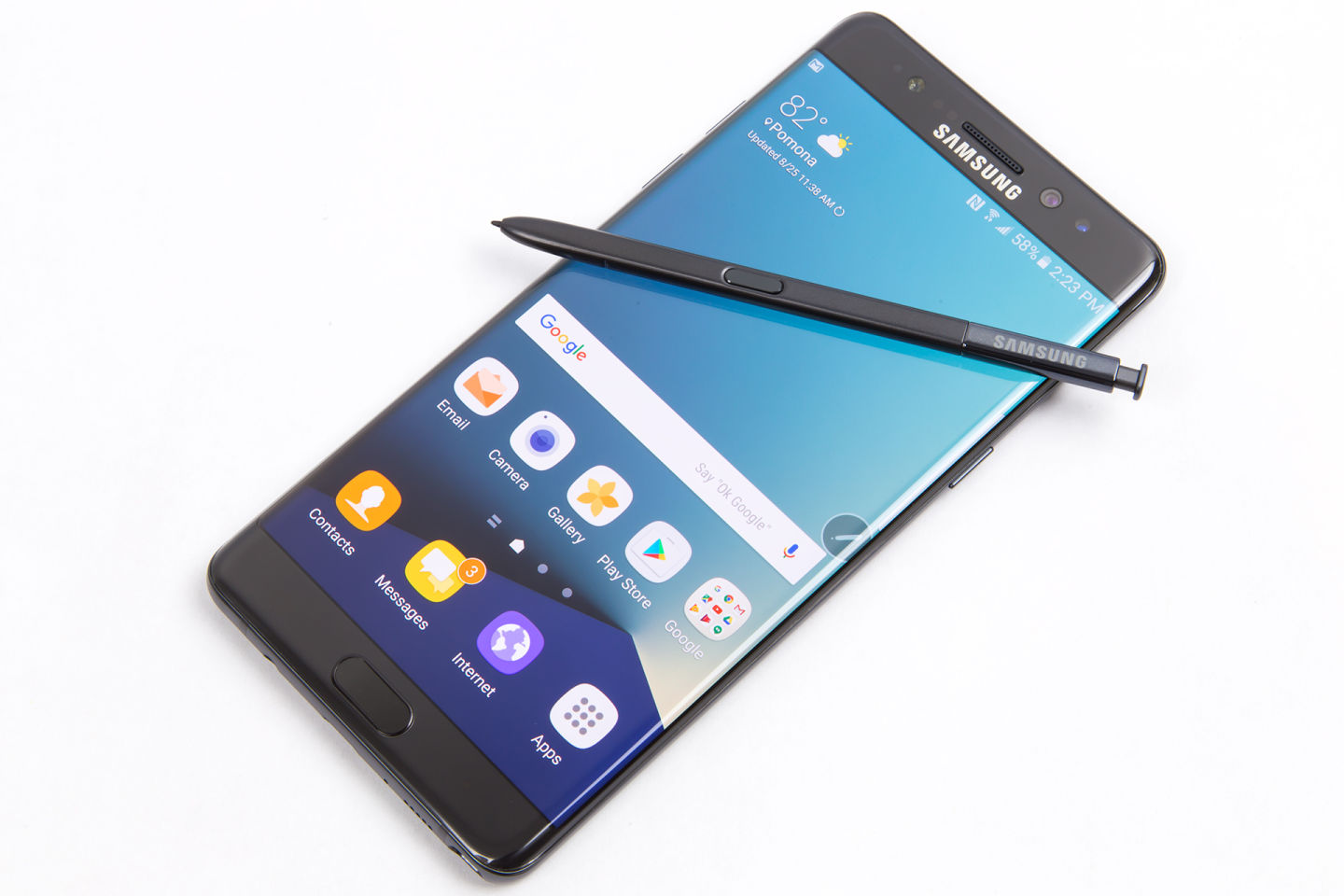
Samsung is in the limelight once again. After announcing results of the Galaxy Note 7 probe, renders of the alleegd Galaxy S8 have leaked online, showcasing its design and some features, notably the "Always on Display."
Samsung's chief Dong-jing Koh has revealed that the Galaxy S8 would not be announced at the upcoming MWC 2017. Nothing has been officially said about the device's launch date, but it is rumored to be announced in March and release in mid-April.
Samsung has a new "8-Point Battery Safety Check" process in tow, aiming to avoid future issues like the Galaxy Note 7 disaster.
The Samsung Galaxy Note 7 launched as an impressive flagship with top-notch specs, but it soon turned out to be a massive liability because of its exploding battery. Samsung was forced to recall the product, assess the issue, relaunch the device with a different battery, and recall it again because the new battery was still not safe.
Samsung went through hell after the recall and discontinuation of the Galaxy Note 7, which kept catching on fire. It all quickly became a PR mess large enough that Samsung could not simply dismiss the issue. An explanation has been long overdue and the Korean manufacturer has finally announced what was wrong with the popular phablet.
Samsung was riding high when the Galaxy S7officially outsold the iPhone 6S and 6S Plus, and even more so when the Galaxy Note 7 came along and impressed everyone — until it went out with a bang. It’s therefore likely to be thrilled to leave 2016 behind and turn its attention to this year’s flagship, which we know as the Galaxy S8.
Lee Jae-yong, Samsung’s mobile communications vice president, has
noted that, for starters, the Galaxy S8 will “feature slick design and
an improved camera, as well as an enhanced artificial intelligence
service.”
Samsung has staunchly encouraged Galaxy Note 7 owners to hand over their devices back to the company given the faux pas everyone is probably all-too-familiar with by now. However, the effort has apparently been less effective than the company hoped, as some are still averse to returning their devices for undetermined reasons.
With gadget buffs waiting for the release of new Android-powered smartphones, February will be an exciting month as major OEMs are gearing up to unleash new devices.
Several speculations and rumors pertaining to the release of top-end smartphones from Samsung, LG and Huawei are swirling online.
Here's a look at some smartphone announcements consumers can look forward to next month.
Samsuvng is expected to release the Galaxy S8 and S8 edge/Plus in mid-April. A new report claims the new smartphones could make an early appearance at Mobile World Congress in late February.
Now that CES is over, smartphone fans are focusing on what's expected to be announced at Mobile World Congress 2017 in Barcelona beginning on Feb. 27.
Samsung is upgrading its Galaxy C series with follow-ups to last year’s Galaxy C5 and C7 in the form of a C5 Pro and C7 Pro. Both the device have been subject of quite a lot of rumors to date, but now we have some official information: The company has quietly launched the Galaxy C7 Pro in China. The phones will join the already-released C9 Pro, which is only available in China.
So what should we expect from the new C-series phones? Here’s everything we think we know so far.
Samsung Electronics Singapore recently worked with SATS Ltd. (SATS), Asia’s leading provider of gateway services and food solutions, to provide Samsung Gear S3 smartwatches for use in technical ramp operations – a world first.
With all 130 of SATS’ technical ramp-handling staff receiving a Gear S3 smartwatch, productivity and workplace safety have been enhanced via the Internet of Things (IoT), helping to streamline on-ground processes and enhance communication, allowing SATS to reallocate resources for greater efficiency.
A new report claims that the 2017 edition of the Samsung Galaxy J3 will go on sale in the US, via Sprint, on January 6. The story says the phone will get the new name of Galaxy J3 Emerge and will also be available via Sprint’s no-contract wireless subsidiaries Boost Mobile and Virgin Mobile.
The report comes from VentureBeat and noted gadget news leaker Evan Blass, based on viewing a user manual for the phone. The Galaxy J3 Emerge will have a 5-inch 720p display and inside it will have an octa-core Qualcomm Snapdragon 430 processor, along with 2GB of RAM and 16GB of on-board storage. By contrast, the 2016 edition of the Galaxy J3 had a quad-core Samsung Exynos chip, 1.5GB of RAM and 8GB of storage.
The Galaxy J3 Emerge will also have a 5MP rear camera and a 2MP front-facing camera, along with a 2,600mAh battery, the same as the Galaxy J3 2016 edition. The Emerge will reportedly be launched with Android 6.0 Marshmallow out of the box.
Pricing for the Samsung Galaxy J3 Emerge on Sprint, Boost Mobile and Virgin Mobile was not revealed in the story, but with its very low hardware specs, we would expect the cost to be in the budget range for smartphones. There’s also no word on when the phone will be released for other carriers in the US.
Great design
Large display is the best for notifications
Rotating bezel is a joy to use
Performance is top notch
Samsung Pay works well
Plenty of features and tools make up core experience
NEGATIVES
Design may not suit many people
Third-party apps can be buggy
4G LTE and calls come at an added monthly price
RATING
Battery. 8.0
Display. 9.0
Performance. 8.5
Software. 8.5
Design. 8.5
Samsung manages to make each feature in its stacked smartwatch work, making the Gear S3 one of the most enjoyable smart wearable experiences we’ve had this year.
8.5
The newest version of the Gear series is a bit bigger, packs a little more punch, and brings a few more tools for the smartwatch enthusiast. Is there enough substance behind the style? We find out in this full review of the Samsung Gear S3.
Before we begin, we will mention that while we are reviewing the Frontier edition, we were able to use the two different editions of it. A Wi-Fi only edition of the watch is available and is more or less the typical Gear experience, while the 4G-enabled edition through AT&T makes it easy use the watch without needing to have a phone nearby and connected.
Design
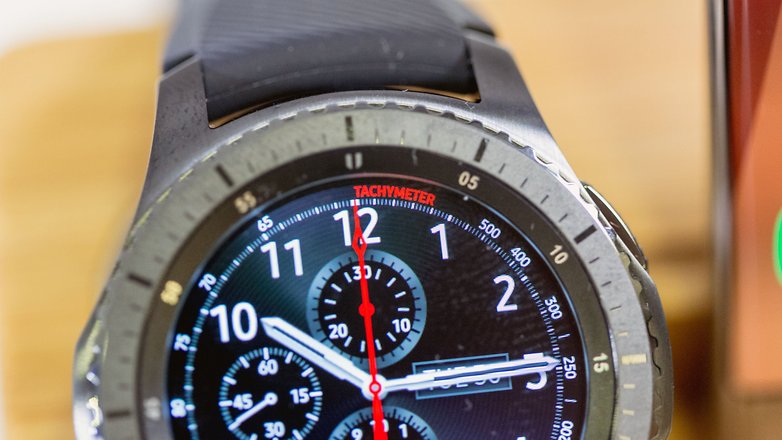
While it might not be easy for everyone to sport this large smartwatch, there is one simple reality for those who can – this is one sleek device. The Gear S3 Frontier brings grooves to the signature rotating bezel, giving it an added tactile quality that is subtle but noticeably felt. Seconds in increments of five line the area just below the rotating bezel – a small detail that adds to any analog watch face. Two buttons are on the right side, one to go backwards in the interface and the other to either go back to the watch face or open up the app list. To differentiate the Frontier and Classic editions, the Frontier’s buttons are more recessed to the body and are covered in a patterned leather.
In adding to the sporty nature of the Gear S3 Frontier, a silicone band comes standard. This helps with the watch’s water resistance, ensuring that no leather will get ruined if one’s wrist gets splashed. However, it is easy to replace the bands through the 22mm standard connectors. A myriad of bands are available from Samsung via partnerships with plenty of fashion companies, but this silicone complemented the style of the Gear S3 nicely.
The body case is a large 46mm, definitely bigger than either of the previous Gear S2models. This size makes it tough to recommend for anyone with small wrists, regardless of one’s gender. Even my own wrists could barely contain the large frame of the watch. While it certainly doesn’t look obnoxious on my wrists, it took a little bit of time to get used to. This size adds room for plenty of features and protection – turning the watch body over reveals the heart rate sensor and designations for the 316L stainless steel material that makes it up. And finally, a MIL-STD 810G rating adds extra shock, heat, and cold resistance to the existing IP certification.
What we really applaud the Gear S3 Frontier for, is its ability to work with plenty of different outfits. While it is most at home among a more formal ensemble, the sleek head-turning design makes it a centerpiece when wearing casual clothing. And to that end, it is hardly a loud device in terms of look – the black color blends in well with most paired clothing.
Which brings us to the marquee feature that returns from the Gear S2 – the rotating bezel. It takes just little tug or a little push in order to make it move, and every click from the bezel is as satisfying as the last. Full touchscreen capabilities are available still, but this physical method of moving around the Tizen interface is fluid, responsive, and as snappy as it should be. Movements far in the interface or just to the next element are equally easy, making this an ideal smartwatch for anyone that wants a tactile experience to, in many ways, replace touchscreen experiences.
Display
And the display is half the story regarding the size of the Gear S3 – at 1.3 inches, the OLED display is covered in Gorilla Glass SR+ (Scratch Resistance Plus) and boasts 360 x 360 resolution. Though these specs might sound a bit run of the mill for most high-end smartwatches, credit goes to Samsung for leveraging it as effectively as possible. OLED lends to really great colors coming from the Tizen OS along with the ability to truly turn off the display’s lighting for battery savings.
And to that end, watch faces on the Gear S3 take on a different nature when the ‘Always on Display’ option is ticked. When using pretty much any watch face downloaded from the Samsung Gear application, covering the display with one’s hand or letting it time out reveals a more toned down version of the face that still keeps the essential elements in view no matter what angle you’re looking at the watch from. For any fans of the Always on Display on the Galaxy smartphones, this is about the closest that it can get strapped onto a wrist.
In all situations – even in broad daylight – the brightness of this OLED panel keeps everything properly viewable. And it is important to have an easy time glancing at the screen because the Tizen operating system tries to pack in as much as it can in the main screen. Some watch faces have hidden functionality when tapped upon. For example, the default face doubles up as a stopwatch. Even when features like these are running, small elements are strewn about the watch face to alert the user to changing circumstances like standing notifications or when the watch is not connected to a smartphone.
Make no mistake – this is the best way to read notifications on a smartwatch. Ever. The combination of the high quality screen and the rotating bezel to scroll down in even long notifications is an experience that is unparalleled by the touchscreen-centric Android Wear and the button pressing Pebble. Even when pictures load up in the preview, they’re shown in effective fashion and simply add to the idea that this watch is supposed to be more standalone than perpetually tethered to your smartphone.
Performance
So, for a watch that wants to do as much as possible, there has to be quite a bit of power under the hood. For the Gear S3, this comes in the form of an Exynos 7270, born and optimized by Samsung and for Samsung, in the case of their own smartwatch operating system Tizen. It comes at no surprise, then, that the watch simply flies through its operating system and applications. A quick spin of the rotating bezel shows how fluidly all of the widgets and screens zip past with no issues at all.
The only problems we had with applications came from third party developed downloads from the Gear Manager. This is not so much the problem of the watch and its processing power, but from the development of the apps. While this is an issue that bears mentioning, the core experience of the Gear S3 is still about as good as it can get – and that says a lot, because this watch tries to do a lot out of the box.
Hardware
As mentioned earlier, we have been able to use a 4G LTE enabled version of the Gear S3 that comes with a few extras. Namely, the ability to sync up the watch without needing to be around the smartphone it pairs with. Setting up the Gear Manager properly means that as long as both the smartphone and smartwatch are connected to some sort of network, notifications will come to the Gear S3, no matter where the user is.
The added benefit is the ability to make calls and send texts in this very situation, without the smartphone around. On AT&T, this service is called NumberSync and it makes it so that the watch goes off alongside its paired phone. Calls on the watch make use of a speaker and microphone combo that is found on the left side of the body, tucked under the top half of the watch. The experience of taking calls on the S3 is akin to a small walkie talkie that is strapped to your wrist, but it isn’t effective in even semi-loud environments and thus requires either a Bluetooth headset connection or, surprise surprise, moving to the phone. It’s a great idea made into reality, it’s just not as awesome as we probably all expected it to be.
Not the mention that having this extra functionality in the Frontier LTE means paying for a smartwatch plan that encompasses data and wireless signal, which costs $10 on top of any smartphone plan you are already paying for. Is it worth that extra money each month? That’s up to you, but we think that there is already so much fun to be had on the Gear S3 without having to shout at your wrist.
Connecting a Bluetooth headset to the watch opens up a couple of possibilities. Not only will calls be easier to manage, but the on-board storage can be used for local music playback. The LTE-enabled Frontier allows for Spotify streaming, which is nice but is a battery drain. 4GB of storage is available for local files so that content is always within reach.
One final feature on the Gear S3 is Samsung Pay, enabled on the Gear S3 through an add-on that is installed in the Gear Manager. The setup takes a little bit of time, but after getting any credit cards put into the add-on and then transferred over to the NFC and MST enabled Gear S3, payments are quite easy at multiple stations across major stores. Simply hold the back button, select which card to use, and then bring the watch up to the station and voila. This is yet another fun aspect to using the Gear S3, and even this skeptic that prefers physical credit cards gets a kick out of it.
The battery of the Gear S3 is charged via a wireless charging dock that is magnetic, making the watch snap right into place easily. Though Samsung claims two days of battery life out of the 380mAh unit, that is less true when usage is constant and aggressive. This is mostly true for the Frontier LTE, in which everything from taking calls, sending texts, and even fitness tracking combined will make the watch seem more like a one day warrior. When using more applications and functions on the regular, be prepared to take the watch off and dock it at least once a day to top off the battery.
Software
And lastly, Tizen – the smartwatch OS of choice for Samsung. Since the Gear S2, there have been some enhancements made to the operating system, and existing Gear S2 users will get this through an update. These are mostly in terms of using the rotating bezel, which can be rotated to answer or decline calls, for example.
The main noticeable changes are in the overall optimization of the Tizen software, and it shows in the smooth look and feel that the Gear S3 provides. Which is good, because there are a lot of apps that require some due diligence. Weather, calendar events, reminders, Flipboard, S Health, and so much more are available to the user, and it can get a little overwhelming. Add upon all that the different ways that users can respond to messages – voice, emoji, canned messages, and a T9 keyboard that is a bit easier to use on the larger screen but is still far from ideal.
S Health returns in Tizen as the main method of fitness tracking. Much like in the Gear S2, S Health will count steps and periodically take heart rate metrics to get a snapshot of the day’s fitness. While its step count default of 6000 is still rather absurd to us, there are a few more tools here to use when going out in the wild. GPS tracking is available when doing distanced based workouts, though it has to be enabled via the specifically selected activity, like hiking. And speaking of hiking, there are barometers and altimeters to get a better handle on one’s environment. Hikers, in particular, will probably find altitude information useful. Other functions in S Health help users track water and caffeine intake along with sleep, but these are rather simplistic in their execution.
The app ecosystem of Tizen has grown a lot since the Gear S2, and some apps that I envied Android Wear and Pebble for during my usage of Samsung’s OS have finally arrived. That said, there are issues with some third party application development, as we mentioned earlier. Sleep as Android, my sleep tracker of choice, is still a little buggy and didn’t give full reports a couple of nights. And S Voice is just not as good as Google’s voice assistance.
All in all, Tizen is an experience that is still best taken at its core, because that is where it shines best. Third party support is still lacking, but Samsung is still able to make it work where it counts – fitness tracking, though sometimes simplistic, is robust; and Samsung Pay helps add a bit of flair to the notification prowess and daily info already built into the Gear S3
Samsung is reportedly planning to use a feature it first introduced on the Galaxy Note 7 with its upcoming Galaxy S8. The company will reportedly use the same Y-OCTA display technology from the Note 7 in the Galaxy S8, which allows for an ultra thin screen. (Photo : Samsung)
The leaks just keep on flowing for Samsung's highly anticipated Galaxy S8 series, which will be released in early 2017. A new report claims the company will use the same advanced Y-OCTA display technology that debuted on the now recalled Galaxy Note 7 in its next-generation flagship smartphones.
The initial launch of the Galaxy Note 7 appeared to be a resounding success, and Samsung reportedly had built 5 million of the devices for release in August. Soon after the Note 7 went on sale, it completely sold out and customers placing an order for the phablet faced up to a three-week delay.
Galaxy Note 7 Features Live On
When Samsung saw that Apple's new iPhone 7and iPhone 7 Plus Jet Black color option was extremely popular, it announced plans to offer the Galaxy Note 7 in a new "Black Onyx" color option that would be released in October. The Black Onyx Galaxy Note 7 would never get released because of a global recall of the device. Instead, Samsung just released a similar hue for its flagship Galaxy S7 edge. Now, the company is about to bring another Note 7 feature to its flagship Galaxy S series, specifically 2017's upcoming Galaxy S8
One of the features reviewers and smartphone fans pointed out during their time with the Galaxy Note 7 was how gorgeous and thin its curved display was. It was the first device from Samsung to use Y-OCTA display technology, which has its touch sensors attached to the display while it is being manufactured, allowing for an overall slimmer display. The company is now reportedly using the same technology in its upcoming flagship Galaxy S8.
Galaxy S8 To Boast Thin Y-OCTA Display From Note 7
ETNews is reporting that Samsung will use the same Y-OCTA display technology it used in the Galaxy Note 7 with at least one of the Galaxy S8 variants. The source claims it will be limited to the smaller Galaxy S8 model, which will reportedly feature a 5.7-inch Quad HD Super AMOLED display with an embedded fingerprint scanner, while the S8 Plus is rumored to pack in a larger 6.2-inch Quad HD Super AMOLED screen.
Samsung has already confirmed a slick new design for the Galaxy S8, which is expected to be unveiled at Mobile World Congress in February 2017. We'll keep you posted on any new Galaxy S8 details as they become available.
Samsung Galaxy A7 (2017) Renders Leak, 360-Degree Video Shows Smartphone In Action
Renders of the next-gen Samsung Galaxy A7 smartphone - the 2017 model - have leaked online, offering a peek into the upcoming device. The 360-degree video of the renders shows off the handset in black, sporting a metal and glass body. (Photo : @OnLeaks | GearIndia)
Samsung has been rumored to be working on the successor on the Galaxy A7 (2016), dubbed the Galaxy A7 (2017), and now renders of the impending phablet have leaked online, offering a peek into the device.
The leak comes courtesy of online publication GearIndia and offers a 360-degree view of the handset.
"Just hours after we posted our exclusive story of Samsung's new affordable Android powered handset - the Samsung Galaxy A3 (2017), we have received some details about yet another upcoming Samsung handset. We are talking about the Samsung Galaxy A7 (2017) edition - which is set to succeed the Samsung Galaxy A7 (2016) currently being sold in several markets across the globe," notes the publication.
What Do The Renders Reveal?
The 30-second video of the renders of the Galaxy A7 (2017) shows off the handset in black. The device sports curved edges and a metal and glass body as rumored. It is difficult to distinguish from the video if the 2017 model of the Galaxy A7 has a bigger 5.7-inch display, or the same the 5.5-inch one sported by the 2016 model.
A speaker grille can be espied on the top right of the device and two volume rockers on the top left. The rear of the handset shows off a camera - possibly the rumored 16-megapixel one - with the flash next to it. The renders show off a svelte and sleek handset that bears a resemblance to its predecessor.
Rumored Specs And Features
The next-gen Galaxy A7 is widely expected to sport either a 5.5-inch or 5.7-inch 1080p display per leaks and benchmark appearances.
Earlier in September, the specs of the Galaxy A7 (2017) sporting the model number SM-A720x were listed on GFXBench. The handset has also received Bluetooth and FCC certification, suggesting that its U.S. release is around the corner.
The impending Samsung handset is rumored to be powered by an octa-core Exynos 7870 chipset and house 3 GB of RAM. The Samsung smartphone will likely offer 32 GB or 64 GB of storage, which will be expandable. The handset is also said to be 4G LTE- and NFC-supported and will possibly offer support for a fingerprint scanner on the front, a first for the series. It could also benefit from a USB Type-C port like sibling Galaxy A3 (2017).
An IP68-certified 3,500 mAh battery is expected to power the Android-powered handset, making it water- and dust-resistant. The Galaxy A7 (2017) is also rumored to tout 16-megapixel front- and rear-facing cameras.
Release
The Galaxy A7 2017 is expected to debut on Jan. 2, 2017 per reports. However, it could be a while before the phablet hits U.S. shelves.
In case you've missed it — which I highly doubt — the Galaxy Note 7 was recalled by Samsung due to risk of malfunction and fire. Although the tech giant has been trying hard to get users to return their Note 7 devices, some of them decided to take the risk and keep using the smartphone.
"As of December 15th, Samsung will modify the software to prevent the Galaxy Note 7 from charging. The phone will no longer work"
In Canada, around 90 percent of users have already returned their Galaxy Note 7. And to make sure that the rest follow suit, Samsung is opting for a strategy it has already used in New Zealand and Australia. The company will soon disable the radios of the remaining Note 7s in Canada, which means that the devices won’t be able to make and receive calls, send text messages, and access the internet.
Starting December 12, Samsung will first turn off the phone’s Wi-Fi and Bluetooth functionality. On December 15, the remaining Note 7's will be barred from connecting to any Canadian mobile network, which will make them effectively useless. The devices will, however, still be able to call 911 in case of an emergency.
Samsung Electronics has officially announced the release of the seventh color edition of the Galaxy S7 edge: Black Pearl. The glossy new colorway, which radiates quality and luxury, will be exclusive to 128GB versions of the device and debut in select markets on December 9.
The new Black Pearl Galaxy S7 edge follows the Blue Coral and Pink Gold editions released earlier this year. While those were largely inspired by calming, natural hues, Black Pearl was designed to be modern and striking. The sleek black finish blankets the entire device – edges and all – and adds depth to its glass design. The result is a stylish all-black aesthetic that captures the essence of the color in its purest form.
In addition to Black Pearl and the other aforementioned editions, the Galaxy S7 edge is also available in White Pearl, Black Onyx, Gold Platinum and Silver Titanium
No flat version
A 4K display5.1-inch and 5.5-inch sizes, or 5.7 and 6.2-inch sizes
likely highlights include a 4K screen, a Snapdragon 830 processor, 6GB of RAM and a massively improved camera.
A dual-lens camera
A 30MP rear camera
An 8MP front-facing snapper
A 4200mAh battery
A 3GHz Exynos 8895 processor in some regions
A 3.2GHz octa-core Snapdragon 830 chip in the US
6GB of RAM
An iris scanner
An AI assistant
A fingerprint scanner in the screen
A mini projector
The Samsung Galaxy Note 6 will be Samsung’s last line of defence against the iPhone 7 later this year.
This year’s Samsung Galaxy Note 6 is going to be EPIC. And that is very good news for long-standing fans of the phablet line, because last year Samsung really dropped the ball and did not bring the Galaxy Note 5 to the UK. Instead it pushed the Galaxy S6 EDGE+ — a bigger, more expensive version of the Galaxy S6. This initiative didn’t go down well at all. In fact, it was kind of a PR disaster for Samsung, who, at the time, wasn’t having the best of luck anyway. Things are very different now, though. The Galaxy S7 is flying off shelves, analysts have their knives out for Apple, and the Android space, at large, hasn’t looked this strong in years — and we’re only just in Q2. The rest of the year looks to be very exciting as well with BIG releases from Samsung, of course, OnePlus, Sony and BlackBerry. OK, granted the latter of which isn’t a MASSIVE deal, but I for one am very interested to see how BlackBerry’s Android project develops. "Making some assumptions about the launch of the iPhone 7 range, the Galaxy Note 6 will have four weeks of retail sales, reviews, and articles, ahead of Tim Cook’s reveal of Apple’s new hardware. If Apple stays true to form those handsets will go on sale in the two weeks after the launch event," says Forbes. "Samsung’s launch strategy would mimic the Galaxy S7 and S7 Edge release schedule which allowed the South Korean handsets to get the jump on Apple’s iPhone SE in sales, mind share, and positioning." The Galaxy Note 6 might not be happening, though; rather, the handset is still coming out with the same specs and hardware outlined in all the leaks, but it potentially will not be called the Galaxy Note 6. No, apparently Samsung is going to call it the Galaxy Note 7 instead. And the reason is because its current Galaxy S flagship is called the Galaxy S7 and Samsung doesn’t want people thinking its new Note isn’t quite as new and shiny as its 2016 flagship phone. Hence the number change. This sort of makes sense, but it is very confusing for consumers and tech-journalists; everybody is expecting the Galaxy Note 6, but when Samsung announces the handset later on this year it will almost certainly be called the Samsung Galaxy Note 7. Guess a few eyebrows will be raised after that, but everything will settle down pretty quickly once word on the the official specs and hardware are confirmed. And I personally think this handset will more than give Apple's iPhone 7 a run for its money. And here are six points expanding on that theory. Insane Specs We already know quite a bit about the proposed specs and hardware for the Galaxy Note 6. Put curtly: this thing is going to be a monster, the likes of which never before seen in the mobile space. We’re talking bleeding-edge CPU technology, top of the line connectivity and 6GB of RAM — yes, you read that right: SIX GIGABYTES of memory. The Samsung Galaxy Note 6 is the next big announcement to hit the mobile space, alongside the OnePlus 3 and Google’s brand-spanking new Nexus phones. The headline-grabbing Galaxy Note 6 has been the talk of the town since, well, just about ALL of 2015/16. The handset, which is believed to feature 6GB of RAM and a new imaging technology, is poised for a release ahead of Apple’s iPhone 7. Samsung has now officially announced its 6GB 10nm LPDDR4 RAM chip and this is now ripe to go inside a handset. And what’s Samsung’s next handset? Yep, you guessed it: The Galaxy Note 6 and that handset as you will all already know has been tipped to feature 6GB of RAM since rumours first started circulating about it. Beyond this the Galaxy Note 6 is tipped to feature a 2K display, new software features for the S-Pen, a raft of next-generation hardware, including a Snapdragon 820 CPU, and a refined design that will no doubt take a few queues from the company’s HUGELY successful Galaxy S7. Sources reckon Samsung is still torn on whether to make the Galaxy Note 6 an edge device; apparently the company is testing multiple models ahead of its official announcement. Also, depending on when it launches, the Galaxy Note 6 could well be one of the first handsets to run Android N. Google’s Daydream VR platform is also likely to feature as well. I say, likely, not certain, because Samsung has some of its own VR aspirations and this could cause some friction between itself and Google in 2016’s VR space. Still, if I were a betting man I’d wager the Note 6 will utilise Daydream; this would go a long way to explaining why it needs 6GB of RAM. This is one handset I am VERY excited about. If only 50% of the rumours are true, it’ll still be one of the best phones in the business -- and that’s saying something with the quality of what’s already available on market at present. Samsung is back, ladies and gentlemen. The uplift will be INSANE. Just a few years ago many gaming PCs only have 4GB of RAM, so the advent of 6GB inside a phone is frankly NUTS. What are you going to be using all this memory for? Is it overkill? Does anyone need this much memory in a phone? At this stage of the game, the advent of 6GB of RAM is likely all about performance. However, developments in VR -- things like Google’s Daydream platform, for instance -- are going to be bringing tons of new uses to phones between now and 2017. And these new features WILL require masses of grunt in order to achieve silky smooth performance. Beyond this there is of course the theory that Google will bring Android and ChromeOS closer together, perhaps even unify the platform, and create a type of hybrid mobile phone that can be used as a phone but also as a console for connecting to HD displays with a connected keyboard and mouse. Basically, when you have this kind of power at your disposal, they sky’s the limit with potential applications. New Camera? The Galaxy S7’s camera is phenomenal and is easily one of the best point and shoot phone cameras we’ve EVER tested. Period. But Samsung isn’t one to rest on its laurels. It knows the iPhone 7 will appear later on this year and the addition of the Galaxy Note 6 to its phone arsenal is its best line of defence against Apple’s hugely anticipated new iPhone. We know the iPhone 7 will be a great camera phone; talk of dual-lens cameras has been going on for some time now. That means Samsung has to up the game with the Galaxy Note 6 and current word on the street suggests we will see some improvements over the shooter currently in use aboard the Galaxy S7. “Samsung is working on a brand new 1/1.7-inch CMOS camera sensor with an aperture as wide as ƒ/1.4,” reports Sam Mobile. “The new sensor could have a resolution of anywhere between 18-24 megapixels. The company is also working on a new compact 1/2.3-inch camera sensor.” It added: “Samsung recently announced that it will not release any new cameras in its NX lineup (at least in some markets), and it has been moving people from its NX camera department to its smartphone department. The South Korean smartphone giant is really focused to improve the image quality on its smartphones, and it seems to have a very aggressive roadmap.” New Note Productivity Features Samsung is planning on introducing a new productivity feature called “Samsung Focus” which we’re expecting to function a lot like the BlackBerry Hub, meaning it will be a place where you can manage all your incoming and outgoing emails, tweets and the like. Samsung Focus reportedly acts as a communications aggregation hub, bringing together, amongst other things, emails from a selection of different sources - again as with BB Hub, the idea is to eliminate the inconvenience of hopping between applications. As with BB Hub it’ll show calendar info, contacts, and memo notes in the same interface too. Beautiful Design Samsung is apparently testing two Galaxy Note 6 styles: 1) normal, and 2) with an EDGE display. Apparently it cannot decide on which to go with, but there will only be one. Our preference? Go with the EDGE, it just looks so much smarter than the normal version on the Galaxy S7. Following the launch of the Galaxy S7, shipments and pre-orders for the Galaxy S7 EDGE appear to be the far more popular than the standard model. And when you’ve seen both in the flesh you will know why. In other words, Samsung punters LOVE the EDGE display. And, yes, it might not be that useful, but as a design feature alone it is stunning and a big USP for the Samsung brand. MASSES of Storage Another first here; the Samsung Galaxy Note 6 is tipped to feature up to 256GB of storage — and, no, not from an SD card. This is internal storage and if true it would be one hell of a USP for the Galaxy Note 6 and its user base. There will also likely be SD-support too. The Galaxy S7 featured it for one and Samsung knows its punters like having the option of expanding the handset’s internal storage -- even if it is a massive 256GB. The other big question is whether or not Samsung will introduce a removable battery inside the Galaxy Note 6. Samsung tends to prefer unibody chassis design these days, so if I were a betting man -- which I am -- I’d put my money on the Note 6 NOT having a removable battery. And the reason will be simple: Samsung will pack a monstrously sized cell in the Note 6 and argue that removable batteries are not required. Of course, not everyone will see eye to eye with Samsung on this -- as evidenced in comments below -- but in today’s space you only really have one option when it comes to handsets with a removable battery and that is the LG G5. ChromeOS Dual-Boot? This is something of a long-shot and something of an "out-there" theory, but a potential scenario all the same. Why does the Galaxy Note 6, as well as other upcoming flagship Android phones, feature 6GB of RAM? That’s a lot of memory for what people usually do on their phones. Plus, there has been talk of a Android/ChromeOS cross-over for quite sometime now with reports suggesting it could happen this year. And what better device to road-test it on than the Galaxy Note 6? UPDATE: Okay, the 6GB of RAM might not be for ChromeOS. Google’s immediate plans for ChromeOS and Android are a bit clearer now and they seem, at least for the time being, only to include support for Android apps on ChromeOS. This is still a HUGE positive for Chromebook users, but still a tad disappointing to me as I was expecting some kind of dual-boot capabilities inside Android N. The reason for 6GB of RAM, save for sheer performance, could well be to do with Google’s Daydream VR platform which will be part of Android N and function on handsets with compatible sensors and displays. Considering how big a deal the Galaxy Note 6 is I’d be very surprised if wasn’t a Daydream-compatible device.
The Galaxy A3 is the entry model in Samsung’s mid-range A series, which comprises the Galaxy A3, A5 and A7. Samsung has given the Galaxy A3 a lot of love and attention in its 2016 update - but has it done enough? We review the Samsung Galaxy A3 6 (2016).
4.7in HD (1280x720, 312ppi)) SuperAMOLED display with Gorilla Glass 4
13Mp, f/1.9 rear camera with LED flash, captures 1080 video
5Mp, f/1.9 front camera
4G LTE
802.11b/g/n Wi-Fi
Bluetooth 4.1
GPS, GLONASS
NFC
Micro-USB
2300mAh non-removable lithium-ion battery
134.5x65.2x7.3mm
132g
PRICE WHEN REVIEWED
£269 inc VAT
The all-new Samsung Galaxy A3 for 2016 is a great upgrade over the 2015 model with an excellent design and very good battery life. It’s priced higher than its faster rivals, but Samsung phones tend to rapidly drop in price - exactly how much the price goes down will decide this mid-range Android’s fate.




 Samsung is reportedly planning to use a feature it first introduced on the Galaxy Note 7 with its upcoming Galaxy S8. The company will reportedly use the same Y-OCTA display technology from the Note 7 in the Galaxy S8, which allows for an ultra thin screen. (Photo : Samsung)